 Winter Tires Canada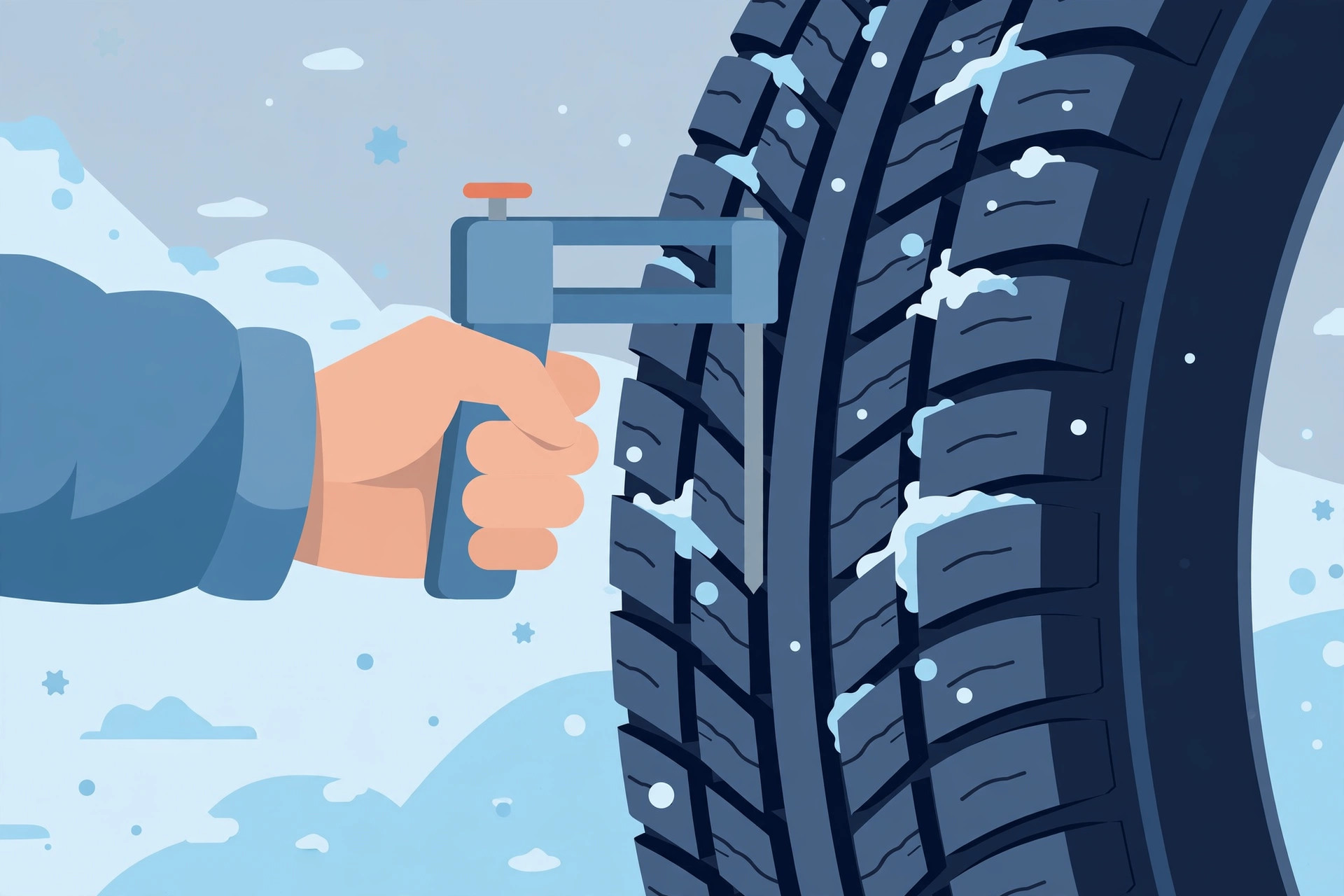
A winter tire does not announce when it is finished. It keeps its shape, holds air, and looks respectable in the driveway long after its grip on snow has quietly gone. The only honest test is a number: tread depth, measured properly, compared against the right threshold — plus a second verdict, on age and damage, that tread alone cannot give.
Why winter tires are done long before they look bald
Tread does three jobs in winter. The grooves channel snow, slush and water out from under the tire so rubber can reach the surface. The tread blocks flex and present edges that bite. And the sipes — the thin slits cut across the blocks — open up hundreds of extra biting edges on ice and packed snow. Wear attacks all three at once: grooves get shallower and clear less, blocks get shorter and stiffer, and sipes, which do not run the full depth of the tread, disappear entirely from the most worn areas. Transport Canada states the underlying fact without decoration: as a tire wears, it loses traction. A winter tire at the legal minimum has not kept most of its winter ability and then suddenly lost it; it has been giving that ability up, millimetre by millimetre, for seasons.
That is why the winter replacement line sits so far above the legal floor. CAA's guidance for Ontario puts the legal minimum at 1.5 mm — and immediately adds that tires lose much of their effectiveness long before that depth, with most experts suggesting replacement once tread falls below about 3 to 4 mm, especially before winter. New tires, for scale, typically start with about 8 to 10 mm. A winter tire at 4 mm is not half worn in any sense that matters; in winter terms, it is nearly spent.
One table, four numbers: sorting law from advice
| Depth | Whose number | Status | How to use it |
|---|---|---|---|
| 4.8 mm (6/32") | Government of Quebec recommendation; CAA-Quebec position | Recommendation | The plan-ahead line: starting a winter at or above this keeps a real margin |
| 4 mm (5/32") | Transport Canada | National safety guidance | The do-not-use line for snow: tires worn close to 4 mm should not be used on snow-covered roads |
| 3.5 mm | British Columbia regulation for designated highways | Law, on those routes | The legal floor for winter tires on BC designated highways — below the safety guidance above |
| About 2 mm | Built-in tread-wear indicators on some tires | Wear marker, not a winter standard | Tires near their wear indicators have less traction and should not be used on snow-covered roads |
| 1.5 mm | Ontario legal minimum (per CAA) | General legal floor | A legality line for tires generally — far below any winter-performance threshold |
Read the table from the top down, because that is the order the numbers bind in practice. The BC figure shows why law and safety must not be confused: a tire at 3.6 mm satisfies the BC designated-highway regulation, yet sits below Transport Canada's snow guidance. Legal and adequate are different verdicts, and winter driving is governed by the stricter one. Quebec's 4.8 mm recommendation, reported from the provincial government and echoed by CAA-Quebec — which does not recommend driving on winter tires under 4.8 mm because grip on snow and ice falls away — is best understood as a planning threshold: cross it during a season and the set can finish that season with attention; start a new season under it and the set is being asked to do a winter it no longer has the tread for.
How to measure tread depth properly
A gauge costs little and removes all argument. CAA is direct that a tread depth gauge gives the most accurate reading, ahead of any coin trick. Measure in fall, before the changeover appointment, so a replacement decision is made with selection and stock available rather than during the first storm.
- Park, cool, and clean. Park on level ground, turn the front wheels to expose the tread, and pick stones and debris out of the main grooves. Measure tires cold and unloaded, the same way each time, so fall readings are comparable year to year.
- Pick the main grooves. Measure in the deep circumferential grooves that run around the tire — not on a tread block, and not in a shallow sipe. Push the gauge's base flat against the tread surface and read the depth where the probe lands at the groove bottom.
- Measure several places per tire. Take readings at three or more points around the tire, and in the inner, centre and outer grooves at each point. Tires rarely wear evenly, and a single centre reading can hide a worn shoulder by several millimetres.
- Record the lowest reading per tire, for all four tires. The decision number for a tire is its lowest groove, not its average — the shallowest part is what meets the snow. CAA's closing advice on measuring is to check all four tires, every time.
- Compare against the staged thresholds. At or above 4.8 mm: run the season. Between 4 and 4.8 mm: this is the last winter — shop during the season, not after it. Close to or under 4 mm: do not start a winter on snow-covered roads with that set. Under 3.5 mm: the set also fails BC's designated-highway requirement.
- Note the wear pattern while measuring. Write down which groove was lowest on each tire. The pattern is evidence, and the next section explains how to read it.
What success looks like: a written lowest-reading for each of the four tires, taken from multiple grooves and positions, that can be compared directly against the threshold table — and a run, plan, or replace decision made from those numbers in October, not from a guess in December.
The coin test: a screen, not a measurement
Canadian guides often reach for a quarter, and used correctly it is a useful sixty-second screen. CAA's version: insert a Canadian quarter into a tread groove with the caribou's nose pointing down; if the nose is visible, the tread is too shallow. A Canadian tire retailer adds the scale the screen corresponds to: if the tread covers the caribou's muzzle, the tire has more than about 6/32 inch (roughly 4.8 mm); if the muzzle shows, tread is at about 6/32 or less and replacement should be considered. That makes the quarter a pass-or-plan screen at approximately the Quebec planning line — handy in a parking lot, decisive enough to trigger a proper gauge measurement, and not a substitute for one. Guides that teach a United States penny test, still common in copied content, should be ignored in Canada: the coin, the portrait and the depth it implies are all wrong for a Canadian driveway. When tread reaches the built-in wear bars — the small raised bars moulded across the grooves, set at about 2 mm on tires that carry them — the discussion is over in the other direction: that tire is finished for winter, and arguably for service at all.
Wear patterns: what uneven tread is telling you
Uneven readings are not just wear; they are a diagnosis, and replacing tires without reading it wastes the evidence. Wear concentrated on one shoulder points toward alignment. Wear on both shoulders, with a healthier centre, is the classic signature of chronic underinflation — the tire has been riding on its edges. A worn centre with healthier shoulders points the other way, toward overinflation. Cupped or scalloped wear, dipping around the tread, suggests worn suspension components or imbalance. CAA states the general rule plainly: uneven wear can signal alignment or suspension issues that need attention. The fix order matters — correct the cause, or the replacement set will wear into the same pattern and be done early for the same reason. Rotation is the prevention: Transport Canada notes that with regular rotation, tread depth should stay similar across the set, and directs drivers to put the deepest-tread tires on the rear when sets differ, to help maintain directional control.
A tread reading cannot clear a damaged tire. Cracks, cuts, bulges or exposed cord end a tire's service at any depth, and a bulge in particular means internal damage. If measuring turns up damage, the verdict is replacement and professional inspection — not another season of monitoring.
Tread is only half the verdict: age and damage
A low-mileage set can show generous tread and still be done, because rubber ages whether it rolls or not. Bridgestone's published guidance gives the industry framework: tires beyond five years old should be inspected by a qualified expert at least once a year, watching for cracking, increased air loss, and new noise or vibration — and tires should be removed from service at ten years of age regardless of appearance, mileage or wear. Age is not a guess: it is moulded into the sidewall. The last four digits of the tire's serial number give the week of manufacture followed by the year, so a code ending in 2319 means the tire was built in the twenty-third week of 2019. Read the code on all four tires each fall alongside the tread readings — full codes sometimes appear on only one sidewall, so the inner face may need checking — and record both numbers together. A set at 5.5 mm and eight years old is not a healthy set with good tread; it is an old set, on borrowed time, whose remaining tread will never be used up before age retires it.
The fall decision framework: run, plan or replace
Combine the three verdicts — lowest tread reading, age, and condition — once a year, in fall:
- Run: lowest reading at or above 4.8 mm, under five years old, no damage, wear even. Book the changeover and drive the season.
- Plan: lowest reading between 4 and 4.8 mm, or age between five and ten years with a clean professional inspection. This set can run one more winter with its replacement already researched and budgeted — it does not get a second plan year.
- Replace: lowest reading close to or under 4 mm, any tire at ten years, any crack, bulge or cut damage, or wear so uneven that one groove is spent while others survive. Replace before the season, in a set of four matched tires, and fix the alignment or pressure cause the old set revealed.
The economics follow the safety, for once. A set replaced in October is bought with choice, stock and installation appointments available. The same set discovered as finished in the first November storm is bought in a rush, at the peak of the season, possibly after a week of driving on tires already known to be done. Measuring is a ten-minute job with a cheap gauge. It is the cheapest decision in winter driving.
FAQ
Is 3.5 mm enough for winter? It is British Columbia's legal minimum for winter tires on designated highways, but it sits below Transport Canada's guidance not to use tires worn close to 4 mm on snow-covered roads. Treat 3.5 mm as a legal line already passed on the way down, not as a target.
Can a set with mixed depths be rotated and kept? Keep the set's depths similar through regular rotation, and put the deepest tires on the rear if depths differ, per Transport Canada. A single tire far below the rest ends the set's winter service regardless.
The tread looks deep but the tires are old. Are they fine? Not on tread's evidence alone. Past five years, get an annual professional inspection; at ten years, Bridgestone's guidance is removal regardless of appearance or remaining tread.
When is the best time to measure? In fall, before booking the changeover — early enough that a replace verdict still leaves time to shop, and again mid-winter if the set started the season in the plan band.